
Solid Aluminum Panels vs. Honeycomb Panels: How to Choose for Your Project
Solid aluminum panels and aluminum honeycomb panels can both be used in architectural cladding, but they are not interchangeable specifications. The right choice depends on panel geometry, support conditions, appearance, installation details and the performance requirements of the complete assembly—not simply on which material is described as lighter or stronger.
In this guide, solid aluminum panel means architectural aluminum single-skin sheet cladding, often formed with returns or other edge details. It does not mean a solid block of aluminum. An aluminum honeycomb panel is a sandwich construction with facing sheets bonded to a honeycomb core. Its behavior depends on the whole construction, including the skins, core, bonding system and edge treatment.
For architects, facade consultants, contractors and procurement teams, comparing these two options is most useful when the design requirements are clear. The following framework explains what to compare and what to confirm before requesting a quotation.
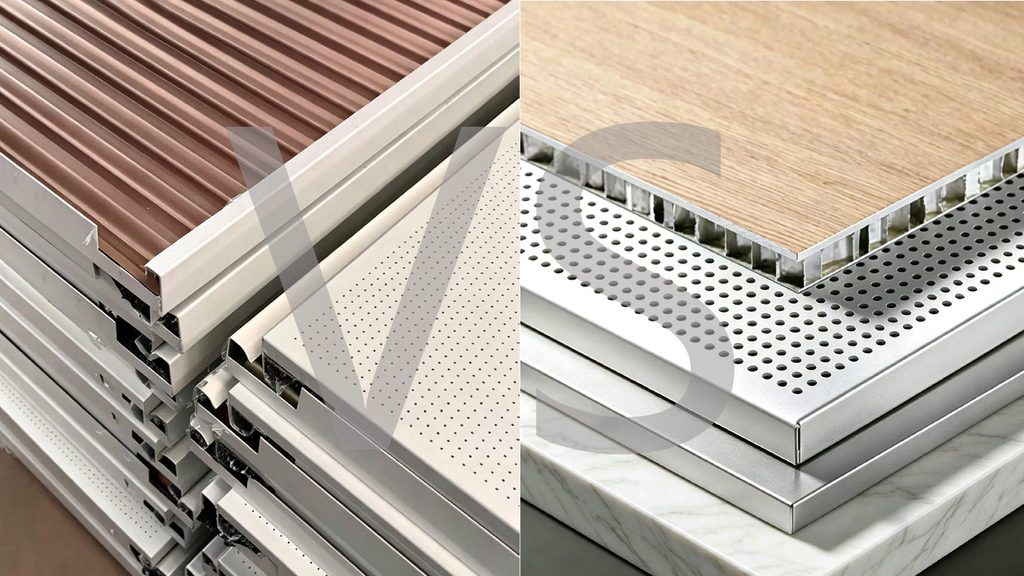
1. Start with the Difference in Construction
Solid aluminum panels
A single-skin panel is formed from an aluminum sheet. Depending on the design, it may incorporate folded edges, stiffeners, brackets or other supporting details. The specified alloy, temper, sheet thickness, panel dimensions and fixing arrangement all influence its suitability.
This construction can be considered for applications involving folded profiles, perforated patterns, shaped surfaces or individual facade cassettes. However, available geometry and fabrication tolerances must be confirmed for the actual design. Not every sheet thickness or finish is suitable for every radius, fold or perforation pattern.
Explore the FTJBM aluminum solid panel series to review the product family before discussing a project-specific configuration.
Aluminum honeycomb panels
Honeycomb panels place facing sheets on either side of a cellular core. Separating the faces creates a sandwich structure that can provide useful bending stiffness relative to its weight. That is a construction principle, not a guarantee that every honeycomb panel outperforms every single-skin alternative.
Face thickness, core depth, core characteristics, adhesive, bond quality and edge details affect the finished panel. Connections and local loads need particular attention: an attachment cannot be assumed to behave like a fixing into solid sheet throughout the panel thickness.
See the FTJBM aluminum honeycomb panel series for the related product family.
2. Compare the Proposed Systems, Not Just the Material Names
| Selection factor | Solid aluminum panels | Aluminum honeycomb panels | What to confirm |
| Construction | Single-skin sheet with project-specific forming and support details | Bonded sandwich with faces and a cellular core | Complete section, alloy, face or sheet thickness, and edge design |
| Stiffness and weight | Depend on sheet thickness, geometry, stiffeners and support | Depend on skins, core depth, bond and connections | Calculations or testing for the actual size, loads and support arrangement |
| Surface appearance | Affected by forming, support, finish and fabrication tolerances | Affected by facing quality, bonding, fabrication and support | Approved sample, mock-up and agreed viewing conditions |
| Shaping | Folded, perforated and curved configurations may be available | Flat and specially formed configurations may be available | Fabrication feasibility and limits for the chosen system |
| Connections | Folded returns, brackets or other engineered details | Engineered edge closures, inserts or other connection details | Load path, movement, durability and installation access |
| Performance documentation | Must relate to the specified panel and assembly | Must relate to the specified skins, core, adhesive and assembly | Applicable project requirements and relevant evidence |
| Cost | Depends on design, quantities, finish and fabrication | Depends on panel construction, detailing and fabrication | Equivalent-scope quotations and installed cost |
This table is a discussion framework, not a product approval. Where structural, fire or other regulated performance matters, involve the appropriate project professionals.
3. Define Panel Size, Loads and Support Conditions
A panel dimension is not a complete structural specification. The same panel can behave differently when its support spacing, fixing pattern, orientation or edge conditions change.
For an exterior application, identify the project location and applicable design actions, including wind loading and any other relevant requirements. For a ceiling or interior installation, establish the applicable loads, support arrangement and safety criteria. The responsible designer should define the design basis and acceptable movement or deflection.
For single-skin panels, ask how thickness, folded geometry and any stiffening arrangement relate to the proposed module. For honeycomb panels, ask how the sandwich construction and connection details carry the required loads, including local loads at edges and attachments.
Avoid selecting either material from a generic “maximum span” or “load capacity” statement without the supporting conditions. A calculation or test for one panel size should not automatically be applied to another.
4. Match the Material to the Geometry and Finish
A flat rectangular panel, a sharply folded cassette and a double-curved surface are different fabrication challenges.
Single-skin aluminum may be a practical starting point when the design relies on folded forms, perforation or particular edge geometries. Honeycomb construction may be worth evaluating when the project seeks a sandwich panel solution for a defined flatness, stiffness or panel-handling requirement. Neither statement replaces a feasibility review.
For curved surfaces, provide the intended radii and clarify whether the geometry is single-curved, double-curved or free-form. Confirm how the finished panel will be made and how the proposed process affects tolerances, edges and connections. A visual rendering alone may not communicate the fabrication requirements.
Also specify the finish accurately: color reference, gloss, texture, coating system and any metallic or directional effect. Request samples where panels will sit next to one another. Different substrates, fabrication steps or coating batches can affect appearance.
For projects that need tailored forming or surface options, review the solid panel customization options as a starting point for a technical discussion—not as confirmation that every option suits every project.
5. Review Fire and Durability Requirements Separately
Do not infer the fire performance of a complete panel or wall system from the presence of aluminum alone.
A honeycomb panel can include adhesives, finishes, edge materials and other components. A single-skin panel is also installed as part of an assembly that may include insulation, membranes, cavity barriers, subframing and sealants. Material classifications and assembly-level requirements are not interchangeable.
Ask which requirements apply to the project jurisdiction and building application. Then check whether the available documentation covers the proposed product construction, thickness, finish and installation arrangement. If a proposed configuration differs from the tested or assessed one, obtain appropriate professional review rather than assuming equivalence.
Durability should receive the same level of attention. For exterior or humid environments, discuss the suitability of the alloy and finish, drainage, exposed edges, joints, bonding system where relevant, and contact with other materials. Define inspection and maintenance expectations.
An unsupported description such as “fireproof,” “rust-proof” or “maintenance-free” is not an adequate project specification. Request relevant evidence and clearly stated limitations.
6. Plan Connections, Installation and Replacement
A panel that meets the visual intent still needs a workable installation detail.
Clarify whether the system uses open joints, sealed joints, concealed fixings or another arrangement. Establish the relationship between the panel, brackets and subframe, including tolerances and access for installation.
For honeycomb panels, review edge closures and connection details early. Cutting, drilling or modifying a sandwich panel on site may affect its construction or performance. The supplier and responsible designer should specify permitted site operations and repair procedures.
For both panel types, allow for thermal movement and the project’s alignment requirements. Ask how installers will set out the modules, manage tolerance differences and avoid damage to finished surfaces.
Replacement also matters. If one panel is damaged later, can it be removed without extensive disturbance to adjacent panels? Are the necessary drawings and finish references retained? Considering these questions before procurement can prevent a visually successful design from becoming difficult to maintain.
7. Compare Quotations on an Equivalent Basis
There is no universal price rule that makes one panel type the better purchase for every project.
Compare quotations for the same design scope. A basic panel price may exclude formed edges, inserts, brackets, finishing, protection, packing or technical documentation. Installation labor and supporting components may also differ.
A useful quotation comparison should identify:
- Panel type and complete construction.
- Dimensions, quantities and geometry.
- Alloy, sheet or skin specifications, and core details where relevant.
- Surface finish and approved appearance requirements.
- Edge treatment, connections and included accessories.
- Drawings, samples, mock-ups and agreed inspection scope.
- Packing, delivery terms and handling requirements.
- Lead-time assumptions, approval dependencies and exclusions.
Assess the total proposed system rather than choosing from an unqualified price per square meter. If an alternative is offered, document what changes and which design approvals are needed.
8. Use This Checklist Before Requesting a Recommendation
The more complete the project brief, the more useful a supplier’s response can be.
Prepare the following information where available:
- Application: Exterior facade, interior wall, ceiling or another use.
- Project location: Relevant environmental exposure and applicable project requirements.
- Drawings: Elevations, sections, panel schedules and connection concepts.
- Module dimensions: Typical and exceptional sizes, with curved geometry where applicable.
- Appearance: Color, gloss, texture, joint pattern and viewing expectations.
- Design requirements: Loads, support conditions and other criteria supplied by the project designer.
- Performance documentation: Required classifications, tests, assessments or approval process.
- Quantities and schedule: Approximate areas, sample needs and approval milestones.
- Supply scope: Panels only or panels with defined accessories and technical support.
- Logistics: Packing, access, handling and delivery constraints.
If some details are unresolved, identify them openly. The next step may be a sample, a drawing review or further engineering input—not an immediate order confirmation.
Discuss Your Project Requirements with FTJBM
FTJBM’s product range includes aluminum solid panels and aluminum honeycomb panels. Use your project requirements to begin a focused discussion about the available systems, proposed panel construction and details that need confirmation.
Share your drawings, approximate quantities, preferred finish and intended application. Ask which options are suitable for further evaluation and what supporting information is available for the proposed configuration.
Discuss Your Project Requirements: Contact sherry@ftjbm.com or use the project inquiry section
Frequently Asked Questions
Are aluminum honeycomb panels always lighter than solid aluminum panels?
Not in every comparison. Weight depends on the complete panel construction, including sheet or face thickness, core depth, edges and accessories. Compare actual specified configurations rather than assuming a fixed weight advantage.
Which panel type is better for a large, flat surface?
Either may be considered, depending on the design. Honeycomb sandwich construction can be relevant to stiffness and surface requirements, while single-skin panels may use formed geometry or stiffening. Confirm the module, support conditions, finish and mock-up criteria before selecting a system.
Can both types be used for curved designs?
Curved options may be available, but the feasible shape and fabrication method depend on the selected construction. Provide the geometry and ask the supplier to confirm radii, tolerances, edge details and supporting requirements for that design.
Does an aluminum face establish the fire classification of a honeycomb panel?
No. The complete panel construction and, where required, the installation assembly must be considered. Verify relevant documentation for the proposed product and project requirements with the responsible professionals.
Should I choose based on panel price per square meter?
Not alone. Compare an equivalent supply scope and account for fabrication, finishes, connections, supporting components, installation and any required technical review. A lower panel-only price does not establish a lower installed cost.